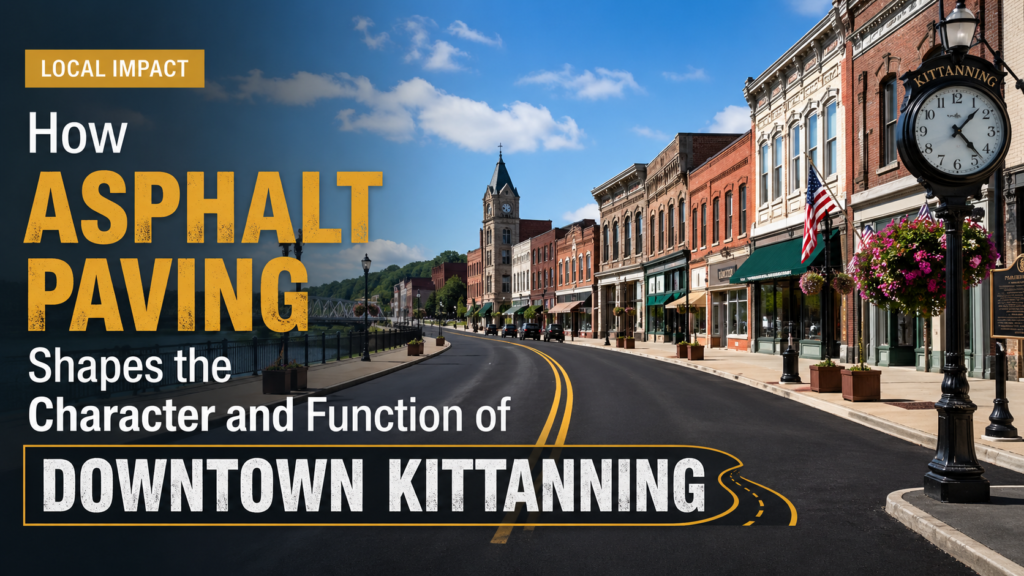
Downtown Kittanning carries a quiet dignity that is rare in smaller Pennsylvania boroughs. Seated along the Allegheny River in the heart of Armstrong County, its historic streets and commercial corridors reflect more than a century of community life. Court Street, Market Street, and the blocks surrounding the Armstrong County Courthouse form a compact urban core where local businesses, government offices, and public spaces exist side by side. And like every functioning downtown, it depends in large part on the condition of the pavement beneath it.
Asphalt plays a more important role in a downtown district than many people realize. It is not simply a surface it is the infrastructure that connects storefronts to customers, delivery vehicles to businesses, and residents to the places they frequent every day. When downtown pavement is in good condition, it operates invisibly. When it deteriorates, it becomes a visible symbol of neglect and a practical impediment to commerce and safety.
Why Downtown Pavement Demands Are Different
Paving in a downtown environment is fundamentally different from residential or rural paving work. The variables involved are more complex, the tolerances are tighter, and the consequences of poor workmanship are more immediate and more visible.
Traffic patterns in a downtown area are mixed and unpredictable. A single parking lot might serve foot traffic from pedestrians, light passenger vehicles, delivery vans, and occasionally service trucks all within the course of a single day. Unlike a private residential driveway where the only vehicles are those belonging to the homeowner, a downtown commercial pavement must be designed and installed to handle this diversity of use without premature breakdown.
Working space is also more constrained. Downtown lots and access areas are often bounded by existing curbs, utility access points, signage, and adjacent properties. An Asphalt Contractor Downtown Kittanning working in a downtown setting must plan equipment access, material staging, and work phasing carefully to avoid disrupting neighboring businesses and pedestrian activity during the project.
Drainage is another critical factor. Downtown Kittanning, like many river communities, sits in terrain where water management requires deliberate engineering. Asphalt surfaces in commercial areas must be graded and sloped precisely to direct water away from building foundations and off paved surfaces without pooling a problem that accelerates pavement deterioration and creates safety hazards for pedestrians.
The Freeze-Thaw Challenge in Armstrong County
Pennsylvania winters are demanding on all paved surfaces, and downtown commercial pavement is no exception. Armstrong County experiences regular freeze-thaw cycles throughout the late fall, winter, and early spring months. During these cycles, moisture that has entered small cracks in the pavement freezes and expands, widening those cracks incrementally with each cycle. What begins as a hairline crack becomes a surface fracture, and what begins as a surface fracture eventually becomes a pothole.
This process is accelerated in areas with heavy foot traffic and vehicle turning movements, both common in downtown commercial zones. The mechanical stress of vehicles stopping, starting, and turning combined with the thermal stress of freeze-thaw cycles places pavement in a downtown environment under conditions that require higher quality base preparation and asphalt specification than a simple straight-run residential driveway.
Local contractors who have worked in Kittanning’s climate for many years understand these conditions in a way that out-of-area firms do not. They know which mixes perform best under local conditions, how deep sub-base preparation must go to withstand seasonal ground movement, and how to schedule work to take advantage of Armstrong County’s relatively narrow optimal paving season.
Asphalt Services Common to Downtown Commercial Properties
Property owners and business operators in Downtown Kittanning typically encounter several recurring asphalt needs throughout the life of their properties.
Parking lot installation and resurfacing is among the most common. Many downtown commercial properties in Kittanning were developed decades ago, and their parking surfaces reflect that age. Resurfacing applying a new layer of asphalt over an existing base that is still structurally sound can restore a parking area to like-new condition without the expense and disruption of complete reconstruction.
Crack sealing and preventative maintenance extend the service life of existing asphalt significantly. For a downtown property, where disruption to daily operations is a concern, maintaining an existing surface through periodic crack sealing and sealcoating is often more practical than deferring maintenance until full replacement becomes necessary. Sealcoating applies a protective layer that slows oxidation and prevents water from penetrating the surface the primary mechanism by which Pennsylvania’s climate degrades asphalt.
Pothole repair and patch work are facts of life in any climate like Armstrong County’s. Professional patching properly cut, cleaned, and filled with hot-mix asphalt rather than cold patch integrates with the surrounding surface structurally and holds up far longer than temporary fixes. For a business whose parking area represents its first impression to customers, a professional repair is a worthwhile investment.
Line striping and ADA compliance work are the finishing details that transform a paved surface into a functional, organized, and accessible space. Properly striped parking areas maximize the number of usable spaces, direct traffic flow, and ensure compliance with the Americans with Disabilities Act requirements for accessible parking and route markings.
The Role of Local Knowledge
Kittanning’s downtown has its own geography, its own traffic patterns, and its own seasonal rhythms. A contractor familiar with the local area understands that work in the downtown core must be planned around the schedule of the courthouse, the opening and closing times of nearby businesses, and the timing of seasonal events along the Allegheny riverfront.
This kind of local knowledge knowing the community, knowing the streets, and knowing the conditions is what separates a contractor who works in an area from one who simply passes through. For property owners along Kittanning’s downtown corridors, working with an established local paving contractor who understands the specific demands of the environment is an important consideration in any paving project.